I have a habit of picking up hobbies that involve making something with my hands — the kind where you start with raw material and a vague idea and see if you can will it into the thing you pictured. Chainmail was the latest. I knew going in it would be equal parts simple and tedious; I didn’t quite know which parts would be which.
The 10,000-foot view is fascinating, but it’s when you get down into the weeds that you find out just how time-intensive making mail really is. You know in your head it’ll be both easy and hard — but knowing that and feeling it are two different things.
The first reality check was the rings themselves. I wound 12-gauge wire tightly around a length of small tubing until I had a coil like a stiff spring, marked a line straight down it, slid it off, and cut the rings free one by one with a jeweler’s saw. Yes, I know you can order rings in nearly any size and material — but I didn’t want to spend the money on an experiment if I could help it, and half the point was to see whether I could.
I owe my way in to a couple of generous resources. I first stumbled onto Chainmailbasket’s weave index, a catalog of more than 1,400 weaves sorted by tradition — equal parts inspiring and intimidating. From there I found Simon Livingston’s “Getting Started Making Chainmail” at Art of Making Things, which laid out the tools, materials, and first weaves in plain terms. I’d have floundered without both.
Then came learning the European 4-in-1 weave. On the surface it’s simple — as the name says, it’s built on units of four rings connected to one. So the logical first step was to make as many of those units as I could, plus a pile of spare singles to link the whole mess together. You’d think connecting the units would be the easy part. It isn’t. Everything moves. Every ring shifts the moment you let go, and you have to keep track of the flow or you end up with a frustrating knot instead of a sheet of mail.
The beginning was the most frustrating stretch, but it did get easier as I went. By the end it came down to something like knitting — or maybe crocheting — except with little unruly rings instead of yarn, and a cat that wants in on it.
A word on scale
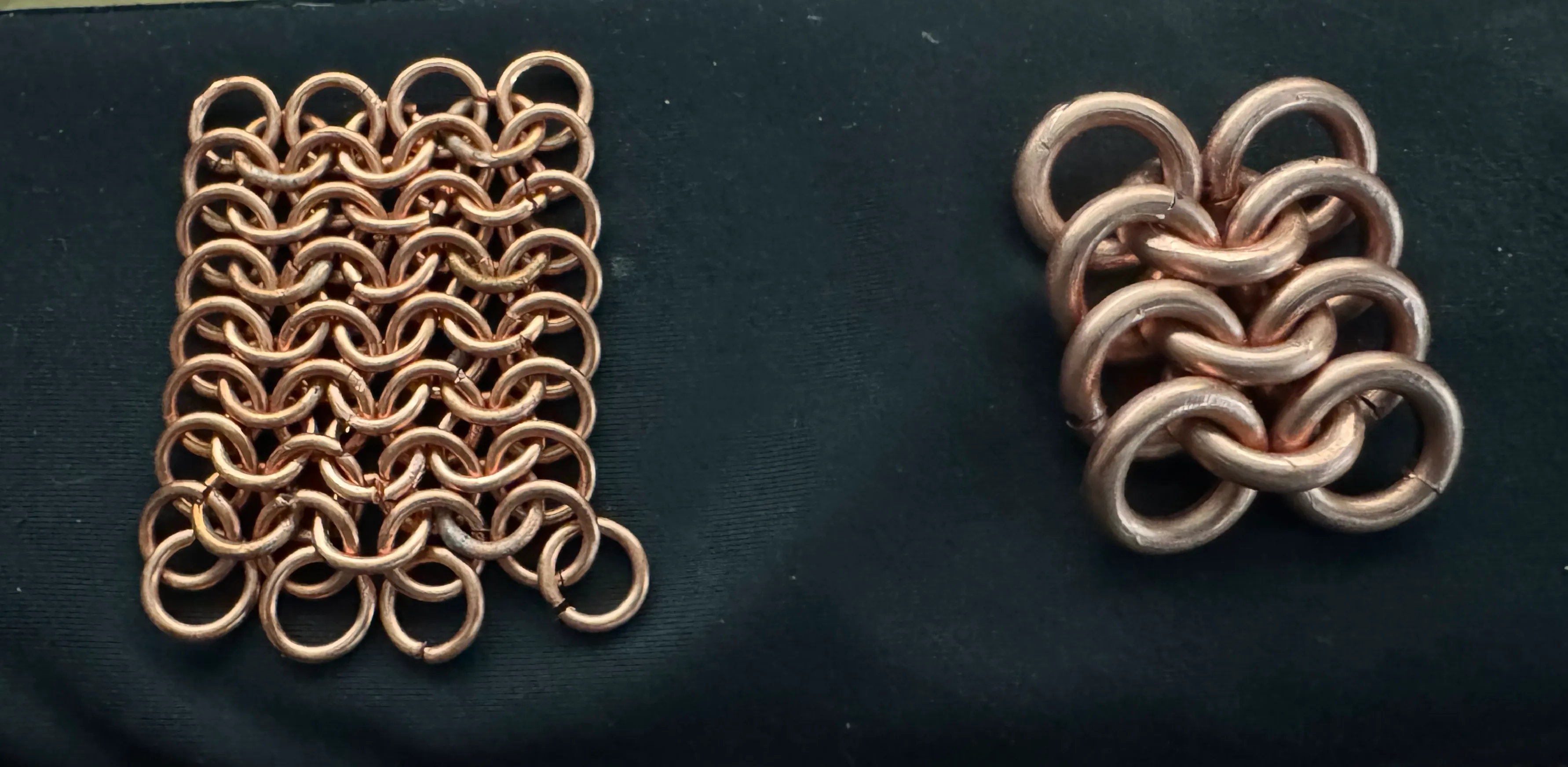
The finished swatch is tiny — about 1.5 by 2.5 inches, roughly 70 rings all told. That’s eight European 4-in-1 units, the rings that join them together, and a few extras I worked in just to see how it would hang. (Add to that a small pile of spares, and the few units I managed to ruin experimenting with soldering.) Very small, but big enough to give me a real feel for the material.
Two things surprised me. First, at this size the mail doesn’t really hang on its own — it wants some kind of weight or separator along the bottom edge to behave. Second, chainmail is unruly around the edges; left to its own devices it wants to curl and snag, so any raw edge needs dealing with — the smaller the piece, the more it shows (a mail handkerchief, say, if anyone were foolish enough to weave one). I’d assume the edges of a full garment would be a bit more forgiving, since they’re anchored into the rest of the weave — though I’ll admit that’s just a guess on my part.
I also made a bit of mail with 8-gauge wire. That was far easier, aside from needing bigger pliers and stronger hands.
So, in summary: at the end of the day, it’s not for me. But I’m still fascinated by the sheer number of weave styles that have shown up independently all over the world — and by the patience of everyone who ever made this stuff because they had to, not because they were curious on a weekend.
- chainmail
- metalwork
- hand tools