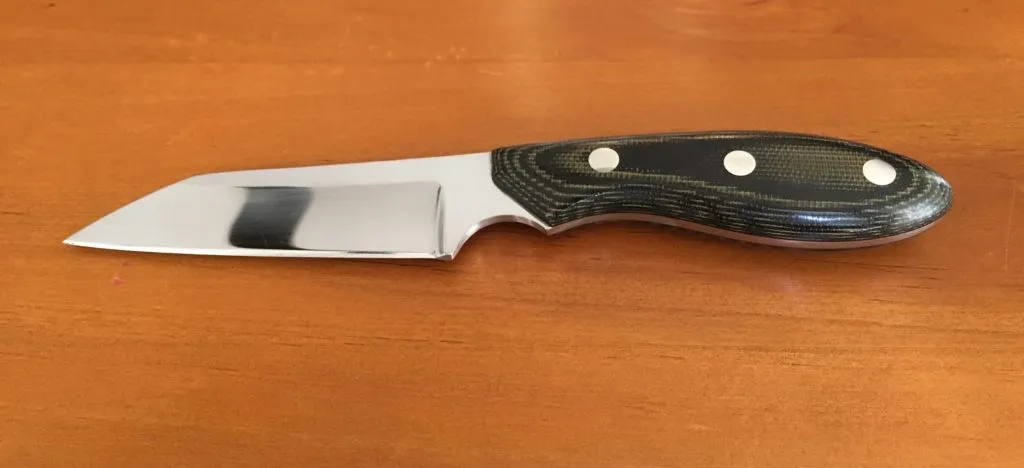
There are so many kinds of steel available, with so many different properties, that choosing the right one for a job can be daunting. Ask any smith and you’ll get a slightly different opinion, based on their experience and sometimes on nothing more than what they like to work with. Here’s how I think about picking steel for a knife.
Defining steel
First, a little grounding. The American Iron & Steel Institute sorts steel into four basic groups by chemical composition.
1. Carbon steels. These account for about 90% of total steel production, and split three ways by carbon content:
- Low carbon (mild) steels — up to 0.3% carbon
- Medium carbon steels — 0.3–0.6% carbon
- High carbon steels — more than 0.6% carbon
2. Alloy steels. These contain alloying elements — manganese, silicon, nickel, titanium, copper, chromium, aluminum — in varying proportions, added to manipulate properties like hardenability, corrosion resistance, strength, formability, weldability, or ductility.
3. Stainless steels. Between 11% and 20% chromium, valued for corrosion resistance. They divide into three groups by crystalline structure:
- Austenitic — non-magnetic and not heat-treatable, so they don’t work for cutting applications. Usually 18% chromium, 8% nickel, less than 0.8% carbon.
- Ferritic — magnetic, can’t be hardened by heat treatment but can be strengthened by cold working. Trace nickel, 12–17% chromium, under 0.1% carbon, plus other alloying elements like molybdenum, aluminum, or titanium.
- Martensitic — 11–17% chromium, under 0.4% nickel, up to 1.2% carbon. Magnetic and heat-treatable, and the group used for knives, cutting tools, and dental and surgical equipment.
4. Tool steels. Tungsten, molybdenum, cobalt, and vanadium in varying quantities, for heat resistance and durability. Ideal for cutting and drilling equipment.
So the best steels for blades fall into three of those: high carbon, martensitic stainless, and tool steels. That still leaves a dizzying selection. Here’s how I narrow it further.
Cost
Steel gets expensive fast, and there’s a limited pool of dealers willing to sell in small quantities. I buy most of mine from New Jersey Steel Baron, but it’s worth looking around at Jantz, USA Knife Maker, and others.
When you venture into the so-called super steels — the powder metallurgy grades like CPM S90V — be ready for sticker shock. If you’re starting out, try the cheaper steels first. You will produce a certain amount of scrap before you make something you’d want to show anyone. Seriously.
Environment
Think hard about where the knife will actually live. You don’t want a steel so tough you can’t maintain the edge with a simple stone if it’s a camp knife that’ll spend its working life in the field. Equally, you don’t want plain carbon steel on a diving knife that will spend its life in salt water.
Expected tasks
No knife should be abused, but in an emergency you want one to go above and beyond and still survive to cut another day. Most stainless steels are more brittle than high carbon steels — which points you toward high carbon for a machete, and stainless for a smaller everyday-carry utility knife.
Heat treat
Heat treating is an entire science of its own, with charts and recipes for coaxing the properties you want out of each type of steel. Stainless brings its own demands: it needs to be treated in an oxygen-free environment to keep from burning the carbon out of the steel.
A good option, at least at first, is to send blades to a reputable outfit like Peters’ Heat Treating. That way you skip investing in a kiln and the rest of the supplies, and you don’t have to worry about warping the daylights out of your blade. I’ve turned more than one piece of steel into an expensive wavy piece of scrap.
If you’d rather do your own, stick with carbon or the tool steels that can be treated in a home-made forge until you’ve got the feel for it.
Final thoughts
Choose wisely. Don’t just go with what sounds cool — it may not be the right fit for the job. For me, part of the fun is the planning. I like to visualize how and where a knife will be used, and plan accordingly.
Editor’s note, 2026
Two things have moved since I wrote this, and both are worth knowing before you take the advice at face value.
The super steel I named is no longer the reference point. In 2016, CPM S90V was the going example of “expensive powder steel that holds an edge forever.” That conversation now revolves around CPM MagnaCut, released in 2021, which was designed specifically to stop forcing the trade-off this article leans on. It’s a stainless that doesn’t pay the usual toughness penalty — so the rule of thumb above, high carbon for the machete and stainless for the small utility knife, is a good default rather than a law. If you’re choosing steel today, MagnaCut is the grade to read about first.
“A reasonable fee” for send-out heat treat has drifted. Peters’ now starts around $110 for one to three blades. Still cheap next to a kiln, a controlled atmosphere, and the blades you’ll ruin learning to use them — but it’s real money per knife, and worth pricing before you plan on it.
Everything else here I’d still say. The AISI groups haven’t changed, and neither has the underlying point: pick the steel for where the knife will live and what it’ll be asked to do, not for what sounds impressive.
Originally published April 8, 2016 on my knifemaking blog; recovered from the Internet Archive and lightly edited.
- knifemaking
- steel
- diy